Evaluating Vintage Floral Deco for Creative Projects
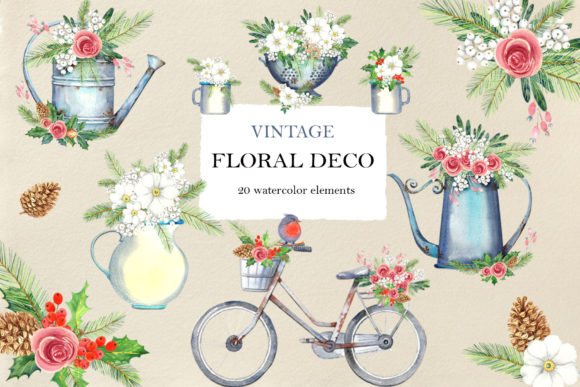
Vintage Floral Deco represents a specific niche within digital design assets, focusing on hand-painted watercolor illustrations that evoke a nostalgic, romantic aesthetic. This collection is defined by its thematic consistency, featuring elements such as a sweet bicycle with a basket of blooms, vases filled with flowers, and watering jugs accompanied by bouquets. For designers, crafters, and content creators evaluating digital assets, understanding the technical specifications and practical applications of this set is essential for determining its suitability for specific projects. The collection comprises 20 distinct watercolor elements provided as PNG files on transparent backgrounds, all originating from traditional media painted on paper and scanned at 600 dpi.
Defining the Asset Collection
At its core, Vintage Floral Deco is a raster-based illustration pack designed to bridge the gap between traditional artistry and digital convenience. Unlike vector graphics which are mathematically generated, these assets retain the organic texture of paper grain and pigment bleeding inherent to physical watercolor painting. The subject matter leans heavily into cottagecore and vintage botanical aesthetics, prioritizing soft edges and muted color palettes over sharp lines and high saturation. The inclusion of narrative elements—such as the bicycle and watering jug—distinguishes this set from generic floral clip art, offering compositional anchors rather than mere decorative accents.
The technical foundation of the set relies on high-resolution scanning. A 600 dpi capture rate ensures that the fine details of brushstrokes and paper texture remain intact even when printed at significant sizes. The delivery format of PNG with transparency allows for immediate layering in software like Photoshop, Procreate, Canva, or Cricut Design Space without the need for manual background removal, streamlining the workflow for users who require efficiency alongside aesthetics.
Primary Use Cases and Audience Fit
Evaluating whether Vintage Floral Deco aligns with your needs requires matching the asset characteristics to specific project goals. This collection is particularly strong for applications where an authentic, handcrafted feel is paramount.
- Print-on-Demand and Stationery: The 600 dpi resolution makes these files suitable for wedding invitations, greeting cards, and packaging. The transparent backgrounds allow for seamless integration onto colored cardstock or textured paper stocks without white boxes appearing around the artwork.
- Digital Scrapbooking and Journaling: For users creating digital planners or memory books, the pre-composed nature of the bicycle and vase arrangements saves time compared to assembling individual flower stems. The vintage tone complements sepia photographs and handwritten fonts effectively.
- Crafting and Sublimation: Makers using sublimation printers or vinyl cutters often seek raster images with clear edges. While watercolor can sometimes present challenges for vinyl cutting due to faint outer pixels, these high-scan files generally provide sufficient contrast for print-then-cut features.
- Branding for Niche Markets: Businesses in the florist, bakery, or antique sectors often require visual identity elements that signal tradition and warmth. These illustrations serve as effective secondary graphics for social media posts, website headers, or product labels.
Benefits of Traditional Media Digitization
The decision to use scanned traditional art over AI-generated or purely digital alternatives offers distinct advantages. The primary benefit is authenticity; the irregularities in paint application and paper absorption cannot be perfectly replicated by algorithms. For audiences sensitive to synthetic imagery, Vintage Floral Deco provides a tangible human touch. Furthermore, the licensing associated with original hand-painted scans typically offers clearer commercial usage rights compared to AI-generated content, which currently exists in a legal gray area regarding copyright and platform acceptance.
The cohesive style across all 20 elements is another significant factor. When sourcing free or disparate clip art, designers often struggle to match lighting, color temperature, and brush styles. Because this set was created as a unified body of work, every element shares the same artistic DNA, ensuring professional consistency across multi-page documents or product lines.
Tradeoffs and Technical Considerations
While the aesthetic value is high, potential users must weigh specific limitations inherent to this type of asset. Understanding these tradeoffs prevents frustration during the production phase.
Raster vs. Vector Limitations
As PNG files, these illustrations have a fixed maximum size determined by the 600 dpi scan. While excellent for standard printing, they cannot be scaled infinitely like SVG or EPS vectors. If a project requires a billboard-sized banner or large-format vehicle wrap, the image may pixelate upon extreme enlargement. Users needing massive scalability should verify the pixel dimensions before purchase or consider hiring a digitizer to convert the raster art into vector paths, though this will alter the watercolor texture.
Color Editing Challenges
Watercolor is inherently blended. Unlike flat vector shapes where colors can be changed with a single click, altering the hue of a watercolor scan requires advanced masking and adjustment layers. If a brand guideline requires a specific shade of teal, but the illustration features sage green, achieving an exact match while preserving the natural shading gradients can be labor-intensive. Users should evaluate if the existing palette meets their needs out-of-the-box.
Transparency Edge Quality
Although the files come with transparent backgrounds, watercolor edges are naturally soft and semi-transparent. In some digital environments or when placed against dark backgrounds, a faint halo or fringe may be visible. This is not a defect but a characteristic of the medium. Crafters using automated cutting machines may need to adjust offset settings to avoid cutting through semi-transparent paint areas.
Comparing Alternatives
To make an informed decision, it is helpful to compare Vintage Floral Deco against other available options in the market.
Versus AI-Generated Florals: AI tools can produce unlimited variations instantly. However, they often lack anatomical accuracy in botany and consistent stylistic coherence across a set. Choose Vintage Floral Deco if botanical realism and ethical clarity are priorities over infinite variety.
Versus Vector Floral Kits: Vector kits offer perfect scalability and easy recoloring. However, they often appear sterile or overly graphic. Choose the watercolor set if emotional resonance and texture are more important than geometric precision.
Versus Public Domain Archives: Museums offer free vintage scans. Yet, these often require extensive restoration, color correction, and background removal. This paid set offers a curated, ready-to-use alternative that saves hours of post-processing time.
Making the Final Selection
Vintage Floral Deco serves as a specialized tool for creators seeking to infuse digital projects with analog warmth. It is best suited for those who value the imperfection of hand-painted art and require high-fidelity assets for print or detailed digital composition. It is less appropriate for projects requiring infinite scaling, precise color matching to corporate hex codes, or modern minimalist aesthetics.
Before acquiring the set, users should audit their current project requirements against the 600 dpi specification and the fixed color palette. Reviewing sample files at 100% zoom is recommended to assess edge quality and texture detail. By objectively evaluating these technical and aesthetic factors against project goals, creators can determine if this specific collection of bicycles, vases, and blooms will effectively elevate their work or if a different asset category would yield better results.